|
Logan County Board
Further opposition to proposed data center at January Regular Logan
County Board Meeting
[January 21, 2026]
On Tuesday, January 20th, the
Logan County Board held their monthly meeting. This meeting is
different from the special one held at the start of the month,
covering all the regular business that the county brought up in last
week’s Workshop meeting. The meeting was held in the second floor
courtroom of the Logan County Courthouse starting at 6:00 p.m.
Eleven of the twelve Board members were present. This included
Chairman JR Glenn, Vice Chairman Dale Nelson, Lance Conahan, Michael
DeRoss, Hannah Fitzpatrick, Keenan Leesman, Kevin Knauer, Bob
Sanders, Kathy Schmidt, Joseph Kuhlman, and Jim Wessbecher. Gil
Turner was the only member not present.
Ron Otto, who came before the Building and Grounds Committee earlier
this month to share a $15,000 donation made Lincoln Christian
Church, was present to give the invocation. To read more about the
gift and what it might go toward, read LDN’s article on that meeting
here.
After the invocation and the Pledge of Allegiance, guests were
allowed to introduce themselves. There were almost a dozen people,
all against the proposed data center, who were present to
represent/speak on the matter. Kiersten Sheets of Trajectory Energy
was present to speak on two community solar projects’ drainage and
decommissioning plans requiring Board approval. Also in attendance
were Logan County Engineer Bret Aukamp of the Highway Department and
Zoning and Economic Development Officer Al Green.

The consent agenda was approved
with no revisions. The agenda included several raffles, as well as
expense reports and other monetary information.
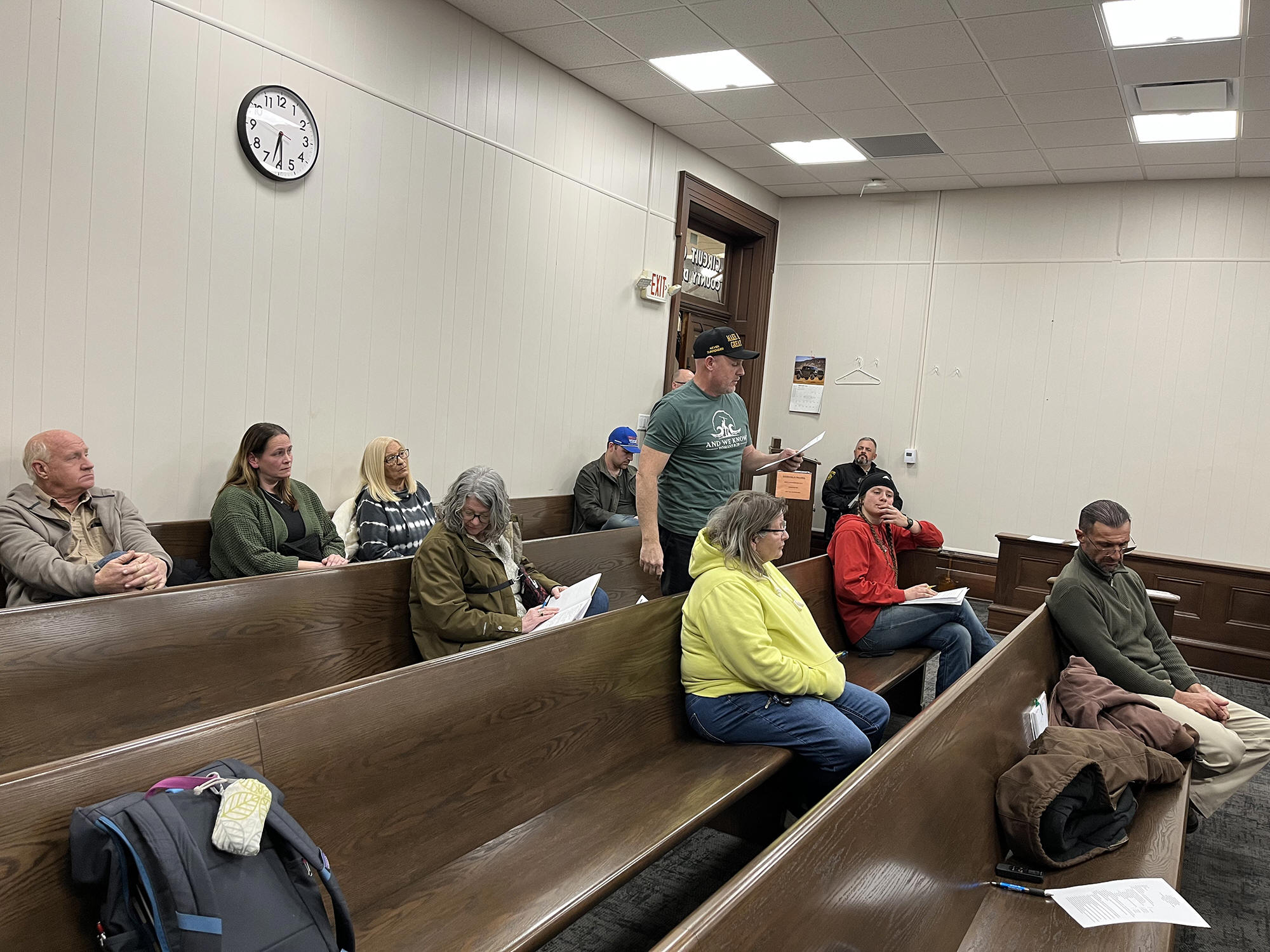
Next was the time for public
comments. All of the comments were relating to the proposed data
center or the rumored solar farm near Chestnut. What follows are
brief summaries of each person’s comments.
Dayton Keyes was the first to speak, talking about transparency. He
brought up that Hut 8 is being sued by their shareholders for not
being transparent on issues regarding Bitcoin. He then stated that
he wanted to see more transparency with the Board, specifically
their financial information. He stated that he does not know that no
one on the Board is being paid off by Hut 8 and so believes that the
members should make a motion to release their financial information
for full transparency.
Next, a woman asked if the Board had signed any non-disclosure
agreements (NDA’s) from Hut 8, to which Glenn informed her that they
had not, an answer that was echoed by a few other Board members. She
then referenced the triple net lease that Hut 8 stated they were
going to have with a potential company at their proposed data
center. She further brought up concern that, if the tenant would not
pay the property taxes, the building would become vacant and a
complete waste of space unless someone purchased the taxes on it to
acquire the center.
Sydney Asherwood then spoke on the reported number of jobs that were
going to be created. She stated that, according to her research,
9,000 gallons of water usage per day was lower than what a facility
of 200 full-time employees would actually use, voicing concern that
the true number of jobs the center would create would be far lower.
The next speaker brought up the fact that Hut 8 does not know what
the data center would be used for at this time, as they do not have
a tenant lined up. He also stated that, according to research he
conducted, a study from the University of Michigan cited two
Illinois communities that saw an increase in energy prices after
data centers went up nearby. He mentioned that the state of Georgia,
while initially reporting that over 5,000 data center jobs had been
created within their state, modified that number to over 1,000,
echoing Asherwood’s concern about true versus claimed job creation.

Anne Ellis spoke next, stating that
she works in Latham. She was concerned with the amount of land that
would be permanently removed from being used as farmland. She echoed
this concern for both the proposed data center as well as the
rumored Chestnut solar farm.
[to top of second column] |

Michael Chandler
was the next to speak, telling the Board that they are being
laughed at on social media. He also stated that Asher Genoot,
the CEO of Hut 8, is the Executive Chairman at American Bitcoin.
Another guest wanted to know why, according to him, Hut 8 was
already contacting the International Brotherhood of Electrical
Workers (IBEW). Glenn stated that, to what he knows, Hut 8 has
not contacted IBEW, but the guest stated that, according to
information he had heard, Hut 8 did do this. Glenn then
explained that no board decision has been made on the proposed
data center. They asked Hut 8 to come and give their
presentation and invited the community in to ask questions.
The next speaker was someone that lives in Latham, stating that
her power bill is $597 per month. She stated that she is on a
fixed income and cannot afford her power bill going up and would
have to move.
The next speaker talked about the bus analogy that was used by
Hut 8 representatives at the meeting earlier this month. He
stated that the power grid in Latham is more like a “clown car.”
He also echoed statements that have been made by several Latham
members at meetings over the month that the community suffers
from power outages. The most recent one the day before this
meeting, and his house got down to 40 degrees Fahrenheit in the
six hours it was out.
Asherwood then spoke again on the jobs, sharing that the data
center jobs would be “insanely complicated.” She expressed doubt
that the jobs would all be Logan County jobs. She stated that
she did not feel like her comments were being heard by the Board
or anyone else that has the power to determine if the data
center goes in. “It feels like I am throwing things into a
hole.”
The next woman, also someone who had spoken before, stated that
she felt people were becoming complacent and that the Board is
going to do whatever they want to do. She also stated that she
feels people are just accepting that their fate will be
determined by someone else.
Leesman then asked if the conditional use agreement for the
proposed data center would be submitted next month. Green stated
that it would not be able to be until March, meaning that the
Board would not see it until April at the earliest.
The next speaker shared that he has a windmill very near to his
home, and wanted to know where the county will stop with energy
projects on farmlands and near homes. Glenn stated that the
state has statutes that the counties have to follow on how much
they can restrict wind turbines and solar farms without getting
sued. He also stated that, several years ago, the Board worked
with someone from Sangamon County to make their ordinance as
restrictive as possible. Green mentioned that the new Senate
Bill that was just passed added battery storage facilities to
that list, but not data centers as of yet.

The board was then asked where each of
them stood on the proposed data center. Conahan stated simply that
he would be voting no. Knauer stated that he wants to hear more
information but is against it for now. Nelson stated that he is
against it, but due to his working in a power plant, he may have to
abstain from a vote due to conflict of interest. Fitzpatrick stated
that she was against it, and Leesman stated that there is not enough
known information on it now to make a vote. Kuhlman echoed Leesman’s
statement, as did Sanders, but added that he is leaning toward a no
vote. Wessbecher was also undecided as was Schmidt, DeRoss, and
Glenn. Glenn stated that the possible increased cost of utilities
stood out to him as a downside.
A woman from the audience then asked Glenn if he did not care about
the people that have to live next to it, as that is what she heard
in his answer. Glenn restated that he only stated that the increased
cost is what stood out to him.
The final comment was on water usage, with someone asking if Hut 8
could build a pipeline to the Mahomet Aquifer. Glenn stated that
there was nothing in the presentation that stated they would. Green
also stated that people who wanted to learn more about what Logan
County’s water usage could look like, that they look at Sangamon
County’s ordinance revisions as that is what Logan County is using
to inform their own revisions.
From here, the meeting moved into the committee reports. For a
rundown of the rest of the meeting and what was passed, please see
LDN’s other article on this meeting.
[Matt Boutcher] |