Brewers' Jacob Misiorowski sets
World Series velocity record on his first pitch
[October 24, 2026]
By RONALD BLUM
MILWAUKEE (AP) — Jacob Misiorowski stepped on the mound for a World
Series debut like no other.
“I had so much adrenaline built up,” he said.
He threw a pitch the likes of which had never been seen in the Fall
Classic.
The Miz broke the World Series velocity record with his very first
delivery, a 103.5 mph fastball to the Tampa Bay Rays’ Yandy Díaz
that was taken high out of the strike zone for a ball. He allowed
one run over five innings to get his first postseason win as a
starter, helping the Milwaukee Brewers to a 3-2 victory in Friday
night’s opener.
“I don’t even know how to tell you how I felt,” the 24-year-old
right-hander said a half-hour after the end of a crazy ninth inning,
prolonged by a game-extending video review. “I still don’t know how
I felt. I feel like I’m still trying to take everything in and
understand what happened.”
Misiorowski gave up four hits and one walk, striking out a
season-low three.
Aroldis Chapman of the Chicago Cubs had the previous mark for
fastest Series pitch at 103.2 mph in the ninth inning of Game 2 in
2016, an offering that resulted in a groundout to second by
Cleveland’s Coco Crisp. The previous high by a Series starting
pitcher since tracking began in 2008 was 101.1 mph by the New York
Mets’ Noah Syndergaard to Kansas City’s Ben Zobrist that was taken
for a ball in the first inning of Game 3 in 2015.

Miz reached 100 mph with 38 pitches, topping the previous Series
high of 24 by Chapman in Game 5 of 2016. The most by a starting
pitcher in the Series had been six by Tampa Bay’s Tyler Glasnow in
the 2020 opener against the Los Angeles Dodgers.
Tampa Bay scored in the fourth when Jonathan Aranda walked, took
third on Junior Caminero’s double over center fielder Garrett
Mitchell and came around on Liam Hicks’ grounder to first baseman
Jake Bauers.
Nearing the end of his first full major league season, Misiorowski
has reached 100 mph with 134 of 260 postseason pitches. But his spin
rate was down, a sign of a season in which he has pitched 188
innings — up from 141 1/3 innings last year. And he got just seven
swings and misses, five on his fastball.
[to top of second column] |
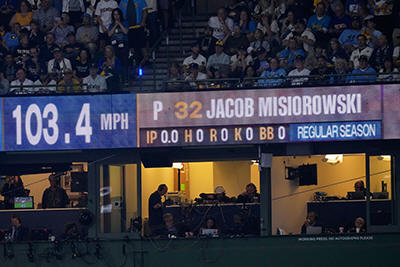
Milwaukee Brewers pitcher Jacob Misiorowski pitch speed is seen
during the first inning of Game 1 of baseball's World Series,
Friday, Oct. 23, 2026, in Milwaukee, between the Milwaukee Brewers
and the Tampa Bay Rays. (AP Photo/David J. Phillip)

Tampa Bay batters fouled off 20 of his 78 pitches
and tipped another.
During the regular season, Misiorowski reached 100 mph with 1,115
pitches, including a high of 105.5 mph to the Chicago Cubs’ Pete
Crow-Armstrong on June 27.
“What we’re used to seeing in the regular season was Miz just mow
through people and have two strikeouts an inning. That’s
unrealistic,” Brewers manager Pat Murphy said. “This is the best
team in the American League.”
Miz's first pitch was so fast the scoreboard at American Family
Field couldn't keep up, flashing 103.4 mph — one-tenth of a mile
less than it registered on MLB’s Statcast system.
“He’s such a special pitcher,” Rays manager Kevin Cash said. “I felt
like for him to be out of the game at five innings, there’s a small
win in that.”
Misiorowski threw fastballs on 10 of his first 12 pitches, then
mixed in more offspeed stuff. In all he tossed 48 fastballs, 17
cutters, seven sliders and six curveballs.
Miz finished with 30 pitches at 101 mph or higher, 11 of 102 mph or
more and three at 103-plus mph.
Warming up in the bullpen, he couldn't take in the introductions
before Milwaukee's first World Series game in 44 years. He thought
about how far he had come, how he was at Double-A Biloxi two years
ago.
“It was crazy," he said. “It’s everything I dreamed of.”
All contents © copyright 2026 Associated Press. All rights reserved |