More flooding in Four Corners region after storms bring heavy rain and
at least one tornado
[October 26, 2026]
By ANNA WILDER and SUDHIN THANAWALA
A rain-soaked swath of the Southwest U.S. endured additional flooding as
crews in New Mexico scoured evacuated neighborhoods Sunday for dead
animals, downed power lines and other hazards left behind by receding
floodwaters and at least one tornado.
With more showers and thunderstorms moving through, the National Weather
Service issued a flood watch for much of the Four Corners region — the
meeting point of Arizona, Colorado, New Mexico and Utah. The area has
experienced unusually heavy rain since Wednesday that caused rivers to
surge, flooding homes and forcing water rescues.
“The soils are very saturated right now, so it’s not going to take much
rain for at least the small creeks and streams to overflow,” said Kris
Sanders, a meteorologist at the weather service office in Grand
Junction, Colorado.
A tornado touched down in Santa Fe, New Mexico, around 7 p.m. Saturday,
and forecasters were trying to confirm whether twisters also struck
elsewhere in the state, said meteorologist Scott Overpeck with the
weather service office in Albuquerque. He did not have damage estimates.
Michelle Vialpando spotted a tornado from her patio in the Aldea de
Santa Fe neighborhood, facing north towards Los Alamos. She had just
gotten home from work and stepped outside to look at what she called
“crazy” storm clouds when she noticed the twister.
“I was pretty surprised at what I was seeing and just started snapping
photos,” Vialpando wrote Sunday via Facebook. “I was literally in shock.
I’ve lived in Santa Fe my entire life and have never seen anything like
that before.”
Many remain evacuated and hundreds are without power in the
Farmington area
In the Farmington area of New Mexico, local officials said swollen
rivers were receding but that many people remained evacuated and
hundreds were without power.
San Juan County, New Mexico, did not have official figures on the number
of homes damaged or how many people were evacuated, but officials were
not aware of any deaths, spokesperson Devin Neeley told The Associated
Press.
“It’s a pretty active disaster zone,” he said.
About 4 feet (1.2 meters) of water flooded the home of county Sheriff
Shane Ferrari. He said the area’s situation was stable Sunday, but he
and other residents were trying to clean up.

Floodwaters could be contaminated with chemicals and raw sewage,
officials warn
Officials in the hard-hit county urged patience and caution Sunday.
Water could be contaminated with chemicals and raw sewage, and gas and
propane lines could be broken, among other hazards.
“The public is anxious to get back in,” San Juan County Fire & Rescue
Chief David Vega acknowledged at a news conference. “But I want the
public to know there are still hazards out there.”
Undersheriff Cory Tanner said officials were going from house to house
to check for hazards — a process that could take days to complete.
[to top of second column]
|
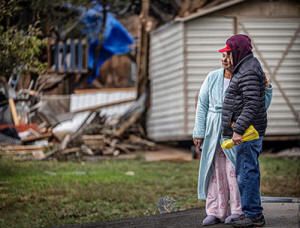
Linda Duran embraces her longtime neighbor Medardo Roybal, whose
home was damaged, in Santa Fe, N.M., Sunday, Oct. 25, 2026,
following a tornado that touched down in central Santa Fe on
Saturday night. (Jim Weber/Santa Fe New Mexican via AP)

Zach and Abigail Flatt started putting together go-bags after
receiving evacuation orders on their phones Thursday evening. Their
home in Bloomfield, New Mexico, sits on the San Juan River, and Zach
drove along the banks watching the water rise at an alarming rate.
“In 30 or 40 minutes it had jumped about four feet,” Zach recalled
Sunday. “After I saw that big jump, and how close it was to going
over the banks, I said we've got to get out.”
By the time the family was loaded into the car, water was coming up
over the tires. They found a hotel room with their two children,
ages 2 and 4, and watched via webcams as at least 18 inches (.45
meters) of water inundated their property, washing away 22 of their
24 chickens.
“We watched stuff just float away, off the porch into the front
yard,” Zach said.
Authorities are still assessing damage in the Navajo Nation and
in a Colorado county
In the Shiprock, New Mexico, area of the Navajo Nation, wastewater
facilities and water holding ponds were damaged by flooding, causing
sewage releases into the San Juan River, according to Navajo Tribal
Utility Authority Shiprock District Manager Wilfred Franklin Jr.
Officials didn't know Sunday how much sewage made it into the river.
New Mexico's congressional delegation on Sunday urged President
Donald Trump to declare an emergency for the state to release
federal assistance funding.
In Colorado, teams were doing welfare checks and aerial scanning to
understand the extent of the destruction from flooding in Archuleta
County. It was still unknown how much damage was caused, but the
sheriff, Mike Le Roux, called it catastrophic. As of Sunday evening,
there were no reports of injuries or loss of life, said Vicki
Shaffer, a spokesperson with the Colorado incident management team.
The flooding is just the latest from two months of on-and-off heavy
rain in the region caused by tropical moisture coming ashore from
the Pacific. After months of drought, other recent deadly flooding
struck the Grand Canyon and other areas of New Mexico.
Forecasters said El Niño, the natural and temporary warming of parts
of the Pacific, was likely to blame for the latest storm's unusually
heavy rainfall.
___
Associated Press writers Anna Wilder in Austin, Texas, and
Christopher Weber in Los Angeles contributed.
All contents © copyright 2026 Associated Press. All rights reserved |