Selma Blair's representatives say she didn't intend to hurt anyone on
flight that led to her arrest
[October 17, 2026]
By ANDREW DALTON and MICHAEL R. SISAK
NEW YORK (AP) — Actor Selma Blair did not intend to harm anyone during a
flight and its aftermath where she is alleged to have assaulted two
flight attendants, a police officer and a nurse, according to a
statement Friday from her representatives.
The long statement sought to push back against what it said were
inaccurate and unsympathetic portrayals of Blair, 54, and the Delta
flight from Los Angeles to New York on Sunday that led to her first
arrest.
“Selma Blair experienced a medical emergency on the flight,” the
statement said. “There was no attempt to open the door of the aircraft.
Selma did not intend to harm anyone.”
A previous statement along with her lawyer's remarks in court had said
briefly that a medical emergency was behind all that happened, but the
new statement gave a more detailed defense.
Blair has multiple sclerosis, and without specifying she had done so,
the statement said it is “outrageous” that anyone would suggest she
doesn't.
“Her diagnosis has been public since 2018,” the statement said. “What
Selma has been able to do physically in the years since is nothing short
of a miracle. She still has bad days, and she lives with pain daily.
Selma also has pseudobulbar affect, a neurological condition secondary
to her MS, which bears directly on how a medical episode presents to
people who do not know her.”
The statement added: “For the same reason, she travels with a service
dog who doesn’t leave her side, and the authorities took her dog from
her.”
The statement said she has been a relentless advocate for disability
rights and the MS community.

Blair was accused of injuring two flight attendants on the plane bound
for John F. Kennedy Airport, then kicking a police officer taking her to
the hospital and kicking a nurse once she got there, according to a
statement from the Port Authority of New York and New Jersey.
She pleaded not guilty Monday to two counts of assault on state charges
involving the officer and the nurse, and a judge issued a protective
order for them. She is free on bail, and her next court date is in
January.
[to top of second column]
|
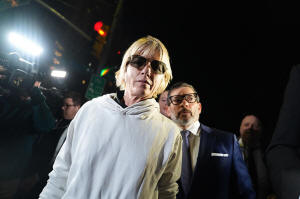
Selma Blair leaves court on Monday, Oct. 12, 2026, in New York after
her arraignment on charges of injuring two flight attendants during
a cross-country flight. (AP Photo/Ryan Murphy)
 The FBI also issued Blair a notice
charging her with assault related to her actions aboard the
aircraft, according to a federal law enforcement official who spoke
to The Associated Press on condition of anonymity because they
weren’t authorized to speak publicly about the matter.
Authorities have released few details of what happened aboard the
plane.
In air traffic communications, the Delta pilot asked the tower to
have medical personnel waiting at the gate to treat bite marks and a
bloody nose, but said ambulances were not necessary.
The Michigan-born Blair began acting in New York in her early 20s.
Her major film roles have included 1999’s “Cruel Intentions,” 2001’s
“Legally Blonde” and 2004’s “Hellboy.”
In 2016, Blair apologized for making statements she later regretted
during a flight from Cancun to Los Angeles. She said she had mixed
alcohol with medication, causing her to black out.
Friday's statement said the public version of the more recent events
has “been built almost entirely on a police statement and a
decade-old headline.”
“A handful of journalists have taken the time to report on Selma as
a human being rather than a headline, and we are grateful to them,”
the statement said. “But fair reporting has been the exception, and
in the space left by our silence, speculation has hardened into
something being treated as fact.”
___
Dalton reported from Los Angeles.
All contents © copyright 2026 Associated Press. All rights reserved |