Georgia amusement park reopens as scheduled after roller coaster death
[October 17, 2026]
By KATE BRUMBACK and RUSS BYNUM
MABLETON, Ga. (AP) — Six Flags Over Georgia opened its gates Friday
evening for the first time since a man fell to his death from one of the
amusement park's towering roller coasters.
A steady trickle of vehicles drove into the park, some of which had
lined up outside about an hour before opening. Most of the visitors said
they hadn't thought about canceling their plans after Hassan Jihad Ibn
Kariem, a 42-year-old school employee from Atlanta, was thrown from the
Goliath coaster on Monday.
“We didn’t plan on riding that specific ride," said Alayna Bruce, who
was visiting the park with family. “Hopefully, we can enjoy all the
other stuff they have.”
Eleanor Adcock, of Griffin, Georgia, said she had second thoughts after
hearing about what happened and said she probably wouldn't be riding any
roller coasters. But she said she still looked forward to the park’s
Halloween-themed Fright Fest attractions of haunted houses and mazes.
“Honestly, I wouldn’t let an incident like this like scare everybody out
of just going out and enjoying yourself,” she said. “But it’s still very
alarming.”
Authorities are investigating what led to Kariem's fall. The park was
already scheduled to be closed Tuesday through Thursday. It reopened as
scheduled Friday evening, though Goliath was not expected to be running.
Witnesses described seeing Kariem ejected from the coaster, and some
people who rode the Goliath before him that day said they had concerns
about its restraints.
Six Flags Over Georgia's park president, Richard Pretlow, issued a
statement Friday afternoon thanking patrons for their support, offering
condolences to Kariem's family and reiterating the park's commitment to
safety.

“While serious incidents of this nature are exceedingly rare, we never
take responsibility to our guests for granted and remain committed to
continuously strengthening our operations and safety practices,” Pretlow
said.
Local officials in Cobb County, where Six Flags is located, declined to
discuss any investigative findings during a news conference Friday.
Assistant Police Chief Damon Ballard said county police plan to wait for
state investigators to determine what went wrong before deciding whether
criminal charges are warranted.
Cobb County's elected commission chairperson, Lisa Cupid, was asked what
she might say to reassure patrons that Six Flags is safe. She said
people should “use their judgment.”
Documents indicate no safety violations related to restraints
The Georgia coaster passed its latest annual state inspection in March
with no safety violations found, according to an Associated Press review
of documents obtained from the Georgia agency that inspects amusement
park rides.
[to top of second column]
|
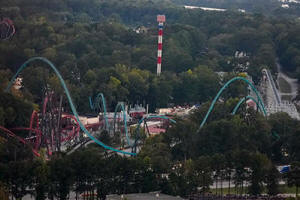
Attractions are seen at Six Flags Over Georgia, about 15 miles (24
kilometers) northwest of Atlanta, Thursday, Oct. 15, 2026, in
Mableton. (AP Photo/Mike Stewart)
 Inspections from 2016 to 2021 found
a total of 18 safety violations related to the ride that included
corrosion on welds, loose handrails in the waiting area and
maintenance needed on grout and padding around the ride’s support
structure. Inspectors said Six Flags corrected each violation within
days. None of the problems appeared to involve the ride's
restraints.
At least 11 roller coasters in the U.S. and Canada — including the
ride on which Kariem died — have been temporarily closed. They were
all manufactured by the same company and equipped with similar
restraints.
Online photos and videos of the coasters show each equipped with
clamshell restraints, which are mounted in front of each seat on a
vertical bar that sits between the rider’s knees. The bar locks the
padded restraint into place over the rider’s lap and upper legs.
It’s unclear from the images whether any of those coasters also have
seat belts or other secondary restraints. Goliath in Georgia has no
such backup restraints.
Manufacturer confident of restraint's safety and comfort
Goliath’s manufacturer, the Swiss company Bolliger & Mabillard, was
granted a U.S. patent for its clamshell restraint system in
September 2001.
In the patent document, the company states that most roller coasters
bind riders in “very tight retention devices” that “detract from
their comfort.” It says the company's clamshell restraints give each
rider a sensation “that he is seated on a flying carpet or that he
is at the controls of a kind of flying scooter, while still
guaranteeing optimum security.”
Bolliger & Mabillard has said by email that it won't comment on the
Georgia death until it has a “better understanding of what
transpired.”
Kariem was thrown from his seat and struck other patrons before
landing below the ride. Goliath, one of Six Flags Over Georgia’s
headline attractions, towers above the park’s entrance. It opened in
2006 and features a series of hills and turns. It doesn’t take
riders upside down, but its first hill rises to 200 feet (61 meters)
and it has a top speed of 70 miles per hour (112 kilometers).
Bynum reported from Savannah, Georgia.
All contents © copyright 2026 Associated Press. All rights reserved |