|
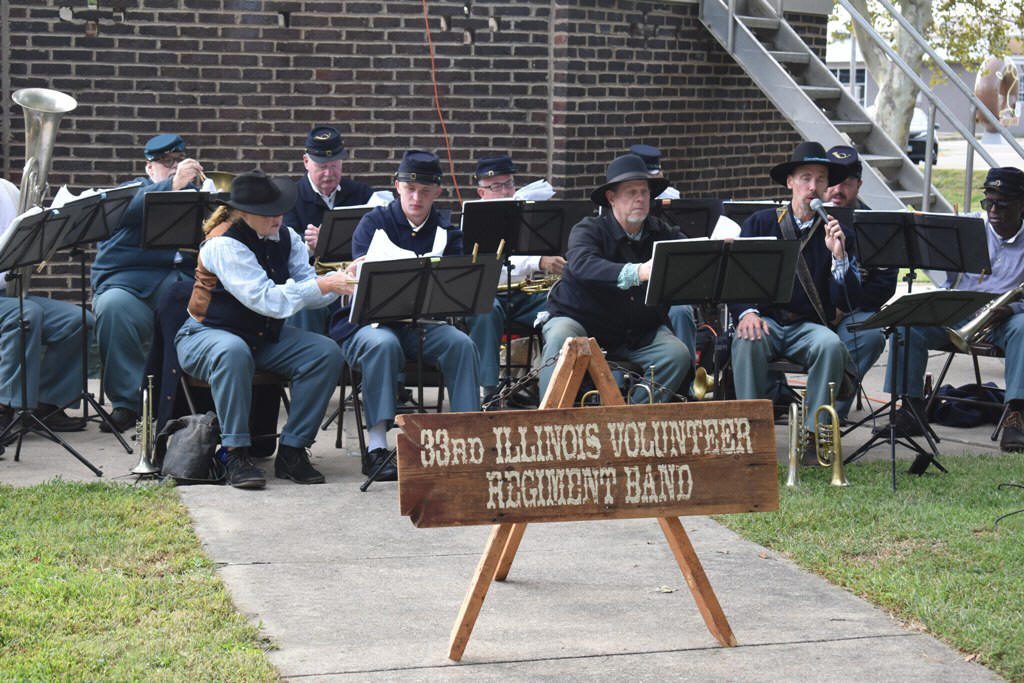
The 33rd Illinois Volunteer
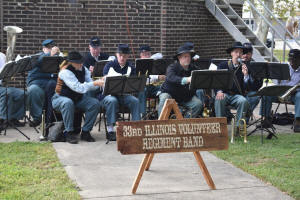
Regimental Band performed an enjoyable and informative concert at
Latham Park on September 27 in celebration of the 250th birthday of
the USA. The Civil War Union army reenactment band played period
music on antique instruments for close to two hours with a short
break for Abraham Lincoln to deliver some remarks.
The band played music that the original 33rd Illinois Volunteer
Regimental Band would have played during the Civil War, which
included quicksteps, marches, ballads, polkas, and overtures. The
same music “provided comfort and encouragement along with a spirit
of patriotism” for the soldiers of the Civil War on both sides of
the battle. The brass instruments that the 33rd play are of the
Civil War era, and one part of the mission of the organization is to
acquire, preserve, and restore these period instruments to their
original condition. The musicians play E-flat and B-flat cornets,
E-flat and B-flat alto horns, E-flat and B-flat tenor horns, and
E-flat bass horns. The rope tension drums are the only period
reproduction instruments used in the band as wood and leather do not
tend to last for purpose.
The band’s website explains that
“The 33rd Illinois Volunteer Regiment Band, Inc. was re-created in
1996, by musicians from Central Illinois. Like the original band,
the musicians were recruited from the same geographical area in
Illinois and come from all walks of life. The band is an authentic
re-creation of the actual Civil War Era band that was mustered at
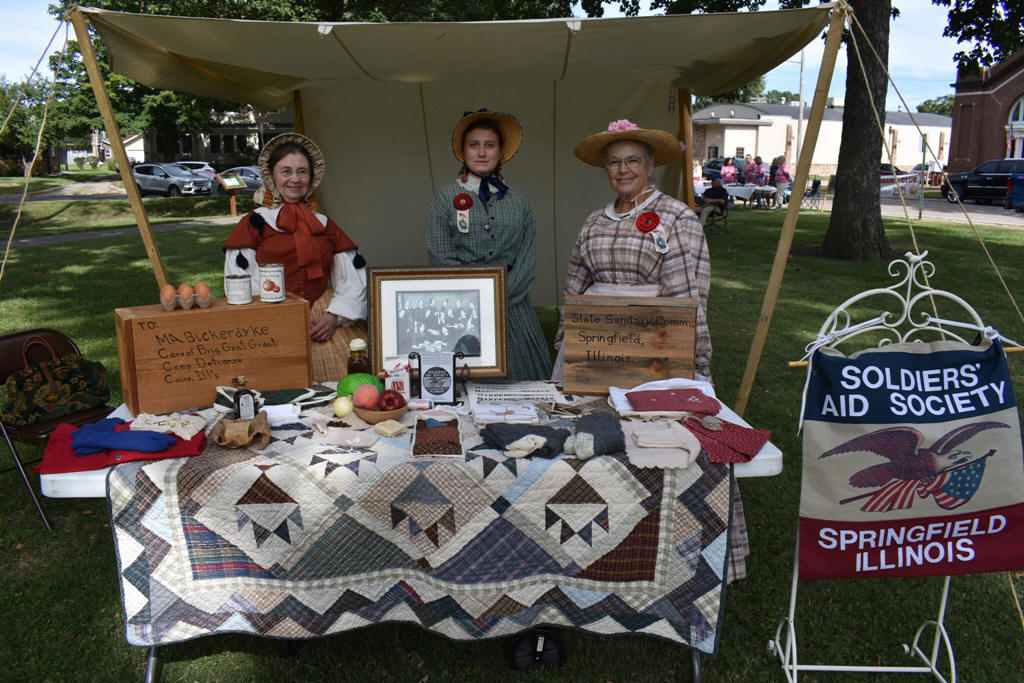
State Normal University in 1861.” Civil War era reenactors of the
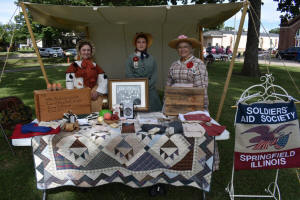
Soldier’s Aid Society of Springfield also attended the concert with
an educational booth about the work of the original society, which
made and gathered items for soldiers during the war. The Lincoln
Woman’s Club provided cake and ice cream for refreshments during the
concert.
The band began the concert with a medley of “When Johnny Comes
Marching Home Again” and “Stonewall’s Way,” followed by the “Slumber
Polka,” which inspired dancers Larry and Shirley Hackmann to take to
the sidewalk to dance. The Hackmanns have traveled with the 33rd
band to Civil War battles sites like Manassas and to about 180
parades to interpret period dress and dances.
The band’s third selection was a medley of songs by Stephen Foster.
The bandmaster explained that many songs were played on both sides
of the Mason-Dixon line, some with different lyrics. Approximately
10,000 new songs were written during the Civil War, 90% of them in
the north. “Maggie by my Side” was another composition by Stephen
Foster, which was turned into a march a couple of decades later. The
band followed this number with a danceable tune called the “Callie
Polka.”
The next song was “The President’s Hymn” written for Abraham Lincoln
who allowed the title when asked for permission by the pastor who
wrote it. A medley of two songs entitled “Twinkling Stars and
Faraway Quickstep” followed and then “Be Kind to the Loved Ones at
Home” and “All Quiet on the Potomac Tonight.” A medley of songs
interspersed with drum cadence completed the first half of the
concert. The medley was based on a poem called “We Are Coming,
Father Abram” written in response to Abraham Lincoln’s request for
more volunteers to join the war effort. No fewer than eight
composers set this poem to music, including Stephen Foster.
During the band’s intermission, Abraham Lincoln delivered some
amusing stories of a captain in his army and of his memories of
christening the town of Lincoln. He offered encouragement about our
freedoms and elections and advised the audience to remember that in
our times of discouragement that nothing lasts forever. He reminded
listeners that it is possible to find common ground even with people
we disagree with.
The 33rd opened the second half of the concert with “Dixie,” the
bandmaster explaining that Lincoln viewed the song as captured
contraband of war and believed that what is captured belongs to all.
Civil War bands also played music for dances– the Virginia Reel was
a popular dance of the time, as well as jigs– so the next number was
called “American Dance Medley.”

Bands often played six to seven
hours a day while on the front. They would wake the soldiers in the
morning, play for marches and battle, and settle the soldiers at
night. During the heat of battle, regimental and brigade band
members were recruited as stretcher bearers, couriers, and surgeons’
assistants, as well as grave diggers post-battle.
For their tenth selection, the band performed the tune “Solid Rock,”
which is recognizable today as the hymn “My Hope is Built on Nothing
Less.” The next number was a medley of jigs and hornpipes for
dancing reels. Hornpipes were dance songs that were played faster
and faster until dancers were in a virtual frenzy, hence the title
of the medley, “Animal Frenzy.”
One in five Union soldiers was born
outside of the USA, and one in 20 Confederate soldiers. There were
some Union regiments that were all German and some all Irish and the
15th Wisconsin was all Scandinavian, with 130 members named Ole. In
recognition of these naturalized citizens' regiments, the band
played the Irish song “My Lodging is on the Cold Ground.” This was
followed by a medley of three songs: “Marching Through Georgia,”
“Rose of Alabama,” and “Yellow Rose of Texas.”
[to top of second column] |
The most popular songs of the
era were sentimental ballads that made soldiers think of home.
Some units banned the playing of ballads because the officers
believed that they increased desertion. Bands began changing
ballads into quicksteps so that they could continue playing the
songs. One example is a song called “Lorena,” which the 33rd
performed in its ballad version and its quickstep version.
The next number was the “Bonnie Eloise Quickstep,” another song
that was originally a ballad. Quicksteps may very well have felt
appropriate at the time because the government allotted three
pounds of coffee beans per soldier per month as part of the food
ration. That is approximately the equivalent of a standard
12-cup pot of today, per soldier, per day. Coffee was not
available in the South because of the Union blockade, so
creative alternatives were utilized such as herbs and sweet
potatoes.
The band next played another traditional Irish melody called
“Star of the County Down” and then a medley of “Yankee Doodle
Dandy,” “Old Abe Lincoln Came Out of the Wilderness,” and
“Listen to the Mocking Jay.” The next number was the famous
“Battle Hymn of the Republic” written by Julia Ward Howe who was
challenged to write better words for a tune with lyrics about
“John Brown’s body moldering in the ground.” She sold the poem
to the Atlantic Monthly in 1862 for $4.

The next to last selection was a
song called “The Battle Cry of Freedom” in the North and “Rally
Round the Flag” in the South. The band began this song with a solo
singer and each member joined in singing the words, just as a Union
soldier had done during a battle when the South had broken the Union
ranks with a side attack, but were called back together by his song,
joined him in singing, and repelled the Confederate attack.
The encore of the concert was a dance number entitled “Attila
Quickstep” written by composer and bandmaster of the renowned 7th
Regiment Band of the New York National Guard, Claudio Grafulla. The
father of John Philips Sousa was a member of the 7th Regiment band
leading to speculation that listening to his father practice
quicksteps and marches influenced Sousa’s future career.
The bandmaster spoke about the importance of military bands during
the Civil War. At the beginning of the war, each regiment, composed
of 1000 men, had a band, and musicians were paid one dollar more per
month than other soldiers. After a year of war, it became apparent
that the war was going to last longer than expected, and the number
of bands was reduced to one per brigade to manage the expense of
employing musicians. Brigades were composed of 10 regiments.
Regimental bands were so important to the morale of some regiments
that the officers kept their regimental bands by reenlistment or by
paying the extra wages from their own funds.
The original 33rd Illinois Volunteer Regimental band participated in
what was called the “western theater” of the war. They “mustered at
State Normal University [now Illinois State University] August 15,
1861. Charles E. Hovey, President of State Normal University, became
the first Colonel of the 33rd Illinois Volunteers when the unit was
organized in McLean County, Illinois. The regiment at once became
known as the ‘Normal’ or Teachers' Regiment and attracted both
teachers and students to its ranks. Because it was stated that the
regiment would not obey orders unless they were absolutely correct
in syntax and orthography, the regiment was at times called the
‘Brain Regiment.’ The 33rd fought throughout the Mississippi Valley
and distinguished themselves at Vicksburg, having lost 11 of 32 men,
all the rest wounded save one.”
The mission of the recreated 33rd Illinois Volunteer Regimental Band
is to preserve and restore Civil War era instruments, to study and
collect 19th century military brass band music, to study the history
of military brass bands, and to apply these to live performance and
to the education of the public. The band performs around central
Illinois and frequently in Springfield at Lincoln’s Tomb Flag
Retreat at Oak Ridge Cemetery and at the Abraham Lincoln
Presidential Library. More information about the history and mission
of the band is available here.
33rd Illinois Volunteer Regimental Band performs at Latham Park
photo slideshow
33rd Illinois Volunteer
Regimental Band performs My Lodging is on the Cold Ground video
[Stephanie Hall]
 |