|
Novice fruit tree owners gathered
at PrairiErth Farm in Atlanta, IL on Saturday, February 7 for a
workshop entitled “Pruning Old, Neglected Apple Trees.” The workshop
was advertised as “one part classroom style learning and one part
field demonstration, with plenty of time for Q & A along the way.”
The program covered “the basics of fruit tree pruning principles
including tree structure, types of growth to remove, and tool
sanitation; how pruning old, neglected fruit trees differs in terms
of strategy, time table, game plan, and tools needed; and how to
actually get the old, neglected fruit tree pruning process started
with electric saws and more.” The workshop was hosted by PrairiErth
Farm, Illinois Extension, and Savanna Institute IL from 1 p.m. to 3
p.m. on-site at the small orchard located on PrairiErth Farm and
presented by Kaitie Adams, John Williams, and Nick Frillman.
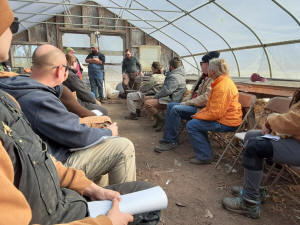
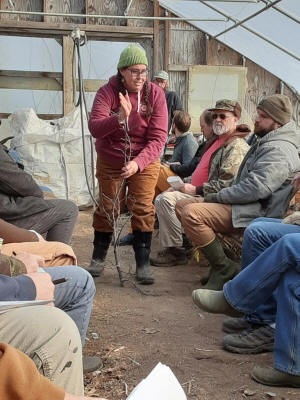
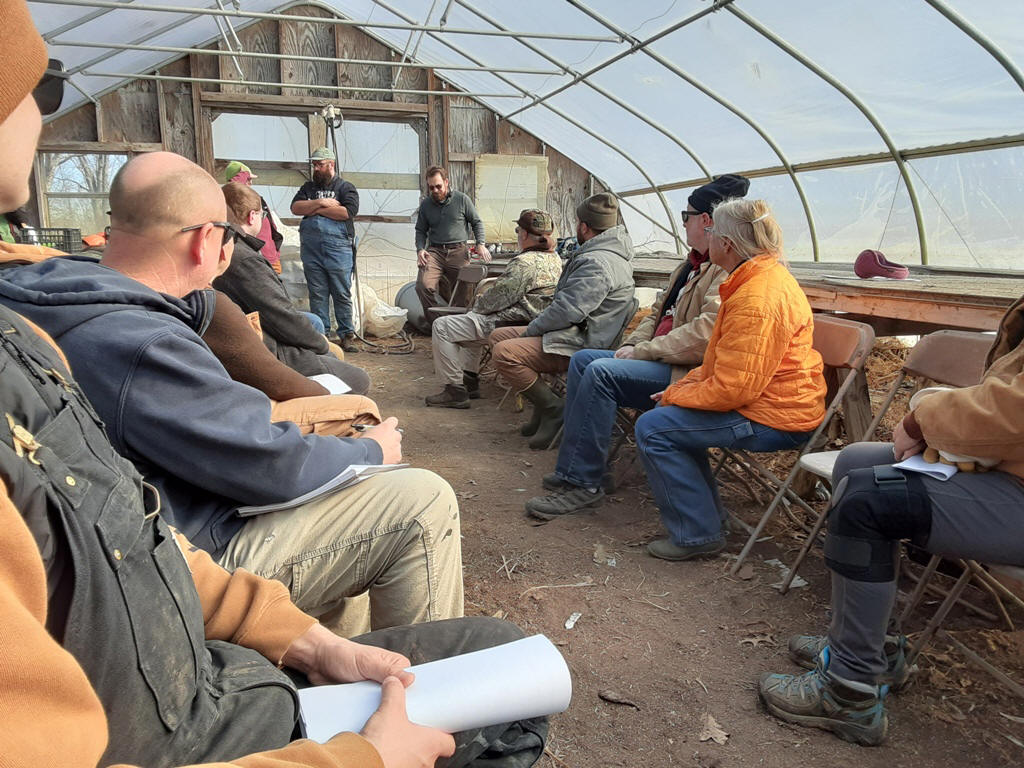
Participants gathered in a large
greenhouse for the initial instruction and enjoyed hot beverages
while Adams, Williams, and Frillman team-taught the essentials of
tree anatomy, pruning basics, and tools for tree pruning. Adams, an
agroforester who is the Demonstration Farm Director at the Savanna
Institute, began by explaining tree physiology. She talked about the
root system that is the main source of water and nutrients for the
tree and keeps it stable. The trunk contains the heartwood, which
provides stability, and the ringwood, which conducts the flow of
nutrients. The cambium of the tree is the vascular system and the
phloem moves sap and becomes the outer bark. Tree branches are for
growth and harvesting the sun. Adams stated, “Trees want to eat
light to produce sugar and seed. Since trees are light-eaters we
want to maximize the light. We want to get as much of the tree’s
needs met as possible.”

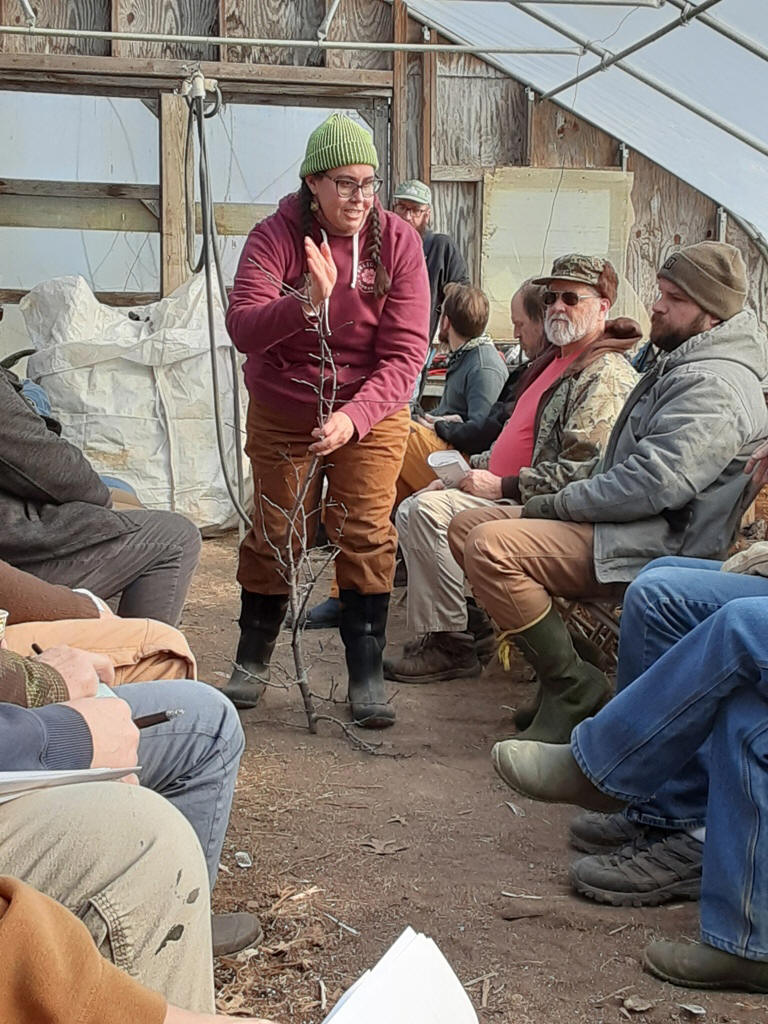
She continued to explain that apple
trees in particular have a short blossoming window and must be
cross-pollinated. On an apple tree branch, the second year or older
growth is what produces the fruit. When pruning, look for the
fruiting spurs because these will produce the most fruit, so make
sure these receive enough light. Adams brought an apple tree branch
to show the various ages of the growth, the growth collar, the
fruiting spurs, the leaf buds, and the flower buds to help
participants recognize what she was describing.
After the introduction to trees, Frillman, a University of Illinois
Extension educator, presented what he called “Pruning 101.” He said
priorities for beginning pruners to consider are air flow, light
penetration, and overall shape of the tree. The goal is to turn the
tree into an efficient solar panel in order to reduce disease
pressure and maximize health and production.
He advised starting pruning with vertical branches called water
sprouts that grow straight up off the scaffold branches and then the
small wood of any crossing branches. Next, move on to the branches
that are shading out other branches and remove the lower branches.
Also assess the tree for damaged and diseased branches, which should
be removed immediately.
The team recommended semi-dwarf trees as the best kind of tree for
new growers. Standard trees can reach 20 to 30 feet or more, which
means collecting all of the fruit may be dangerous or impossible.
Standard trees are best for when some of the fruit is meant for
wildlife. Dwarf trees are shorter in stature, but also more
shallow-rooted meaning that they may need supports and specific
types of soil. Semi-dwarf is the most manageable size for those
looking to get started growing fruit trees.
The presenters then explained and demonstrated various tools for
tree pruning. The basic tools that everyone caring for trees needs
are a hand-held bypass pruner and a pruning saw with a locking
mechanism (so that it will not fold on your hand). In addition to
these basic manual tools, loppers of various sizes are available
including ratcheting, telescoping loppers. Pole saws and battery
operated pole pruners are good for reaching high, thinner branches.
There are plenty of power tools which increase the convenience, as
well as the price and the danger. Chain saws are convenient for
larger branches, and electric ones are the easiest to start and the
quietest. Adams pointed out that chain saws are built for a man’s
center of gravity, but the smaller electric chain saws better fit a
woman’s center of gravity, which is different from a man’s. Adams
can safely cut overhead branches and bend forward to cut logs on the
ground with an electric chain saw. There are also battery-powered,
hand held bypass pruners that cut thin branches with the push of a
button. Adams strongly advised everyone to learn to always prune
with one hand in your pocket, whether using a manual or power tool,
to avoid finger and hand injury.
[to top of second column] |

Participants collected handouts
with information and links for more information to review and
practice on their own trees later, and then the group left the
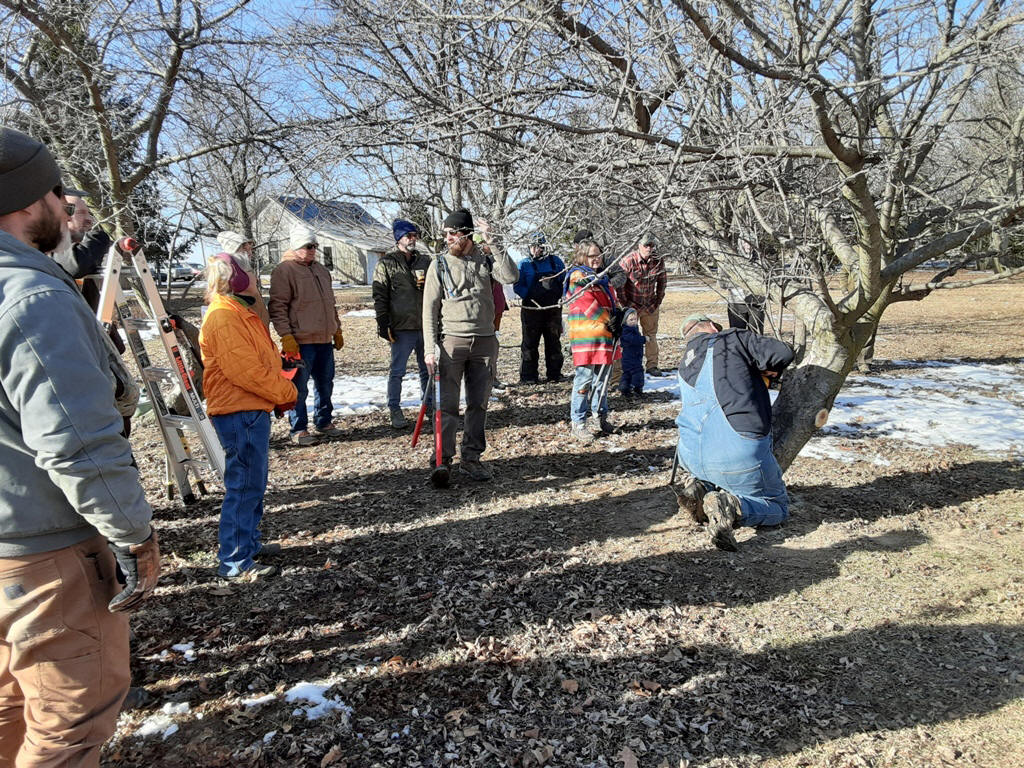
greenhouse for the demonstration part of the workshop. Behind
the greenhouses were a small group of fruit trees planted in
2004. The presenters led everyone to a Golden Delicious tree,
which was a good producer, but had not been maintained for
several years. Knowing the cultivar of the tree helps to know
how it will grow and subsequently how best to prune it. For
example, the trunk of the Golden Delicious was growing out of
the ground at an angle, which is common for that cultivar.
Therefore pruning to remove the heaviness on one side if the
tree is leaning will help the tree withstand pressure from wind,
ice, and fruit load.
The presenters pointed out water sprouts and a diseased branch
on the tree that needed to be removed, which led to a discussion
of disease. The three primary vectors of disease for trees are
leaves on the ground, cut branches, and mummified fruit still
clinging to the tree or on the ground. Mowing or removing leaves
and removing cut branches and mummified fruit can go a long way
in disease prevention. Any diseased branches that are removed
should be hauled away from the tree and burned.
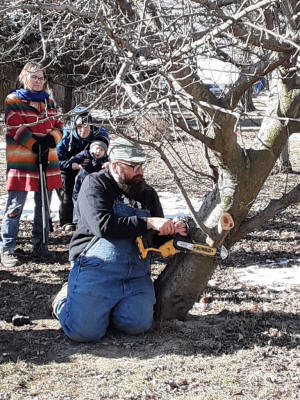
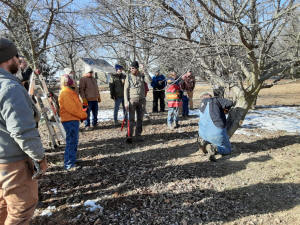
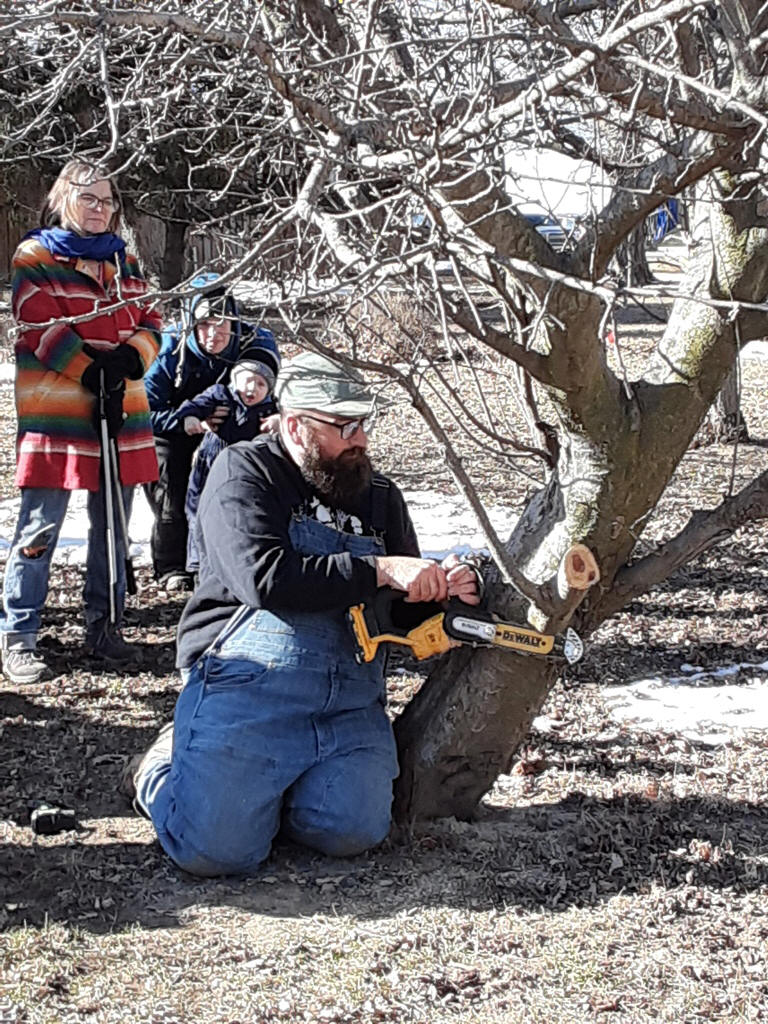
Williams demonstrated cutting off
some large lower branches with both a chain saw and a pruning saw.
The branches that were removed were causing heaviness on one side,
were in the shade of higher branches, and were low enough to
interfere with mowing. Whether using a pruning saw or a chain saw on
larger branches, it is important to undercut as the first cut to
avoid ripping the bark when the limb falls. The second cut comes
from the top to sever the branch and, if needed, the third cut,
straightens the cut so that no parts of the wood are sticking out to
trap water and promote rot. Wounds on the tree do not heal, but they
grow over from the collar, so it is important to leave the collar
and to cut flush with the collar rather than the tree. Disinfect
tools by spraying isopropyl alcohol or alcohol-based hand sanitizer
on the blades, ideally between each cut, but definitely between each
tree to prevent spread of disease.
A question arose about sealing the wound after a pruning cut, which
has been standard practice for many years using a petroleum-based
sealer or wax. It is marketed as preventing bacteria from entering
the wound, but it is a trade-off with the collar healing over. Adams
said that the most recent research does not recommend using pruning
sealing because of the potential for trapping harmful bacteria,
while keeping out the beneficial bacteria.

Additional instruction for pruning
is to never take off more than 30 percent of a tree in one season
with the exception of diseased or dead branches. Piling the pruned
branches together can help you get a sense of what percentage you
have cut as you go. Always be sure to walk around the tree while
pruning to make the best judgements about where the 30 percent
should come from. In other words, don’t take all 30 percent from one
side. A drone can help spot where air flow or light penetration may
be needed from the crown. Taking off more than 30 percent will
result in a vegetative season of leaf growth to recover from the
damage at the expense of growing fruit the following season.
Additionally, although apple trees may look like the perfect
climbing trees, never climb them as that can easily damage them.
At the end of the informative workshop and demonstration,
participants had the opportunity to identify branches on other trees
they felt should be removed and to try their hand at it, if desired.
The presenters were available for general questions about best
practices, as well as individual advice about participants’ specific
trees. For more information about tree care including selection,
planting, harvesting, and pruning basics, visit the U of I Extension
page “Fruit Trees for the Home Garden”
here.
Fruit tree pruning workshop photo slideshow
[Stephanie Hall] |