Brock Nelson scores twice as US
opens the Milan Cortina Olympics by rolling over Latvia 5-1
[February 13, 2026]
By STEPHEN WHYNO
MILAN (AP) — The U.S. goal song — “Free Bird” by Lynyrd Skynyrd —
blared seven times over arena speakers Thursday night. Twice, the
celebration was only short-lived.
Bouncing back from having a pair of goals wiped out by coach's
challenges, the U.S. opened the Olympics by rolling past Latvia 5-1
in a dominant showcase of some of the country’s best NHL players.
Brock Nelson scored twice, four players had two assists apiece and
there was production up and down the lineup.
“We believe in the depth we have,” winger Jake Guentzel said.
“There’s good players on every line. That’s just where American
hockey is right now.’’
After a weird first period with a couple of video reviews and a
tying goal by Latvia, the Americans found their groove and for long
stretches barely let their opponents have the puck. The U.S. outshot
Latvia 38-18 and needed starter Connor Hellebuyck to make only 17
saves.
“I felt like we controlled the play,” center Jack Eichel said.
“We’re going to continue to get better every game in this
tournament, every period in this tournament. That’s our goal, and
it’s a good start for us.”
Elvis Merzlikins was under siege at the other end, and after
Nelson's second goal he sat in the crease with his head bowed in his
lap. An odd-man rush became a version of the Harlem Globetrotters on
ice with pass after pass: Jack Hughes to brother Quinn to Matthew
Tkachuk, back to Jack and then to Nelson to tap into a half-open net
with 11.1 seconds left in the second period.

“I don’t think there’s much to do,” Merzlikins said. “If that guy
wouldn’t score, probably the other guy would score because I felt
completely two open guys, and it’s hard to save something like
that.”
Brady Tkachuk scored the first U.S. goal of the tournament less than
six minutes in, and Tage Thompson roofed a nifty backhander on the
power play, making coach Mike Sullivan look smart for putting the
6-foot-6 winger on the loaded top unit. Four goals on 32 shots was
enough to chase Merzlikins, who was pulled to start the third for
Arturs Silovs.
Captain Auston Matthews welcomed Silovs to the Olympics with a
power-play goal, assisted on by Eichel and Quinn Hughes. Each of
them had two assists, along with Matthew Tkachuk and Jack Hughes.
“I just think the depth that we have, it showed,” Brady Tkachuk
said. “I thought everybody played a great game tonight. You just see
the buy-in. You see the buy-in of every line playing the right way.”
The U.S. plays Denmark on Saturday night before wrapping up the
preliminary round 24 hours later against Germany.
Canada looks like the favorite, beating Czechia
Macklin Celebrini scored Canada’s first goal in the return of the
NHL to the Olympics and Jordan Binnington stopped all 26 shots he
faced in a 5-0 defeat of Czechia that showed the tournament favorite
is already a well-oiled machine.
“Our intentions were really good with the way we played,” captain
Sidney Crosby said. “I thought we were physical. We were moving our
feet. The execution, sometimes that comes with time. But even other
times we did some good things and executed well. Just a matter of
building off of that.”

[to top of second column] |
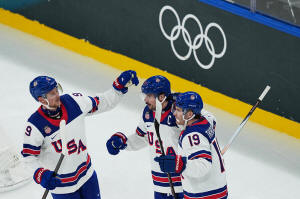
United States' Auston Matthews, center, celebrates with teammates
after scoring his sides fifth goal during a preliminary round match
of men's ice hockey between Latvia and the United States at the 2026
Winter Olympics, in Milan, Italy, Thursday, Feb. 12, 2026. (AP
Photo/Carolyn Kaster)

Celebrini, his country’s youngest player at 19,
deflected a shot by Cale Makar past Lukas Dostal with 5.7 seconds
left in the first, putting an exclamation point on a terrific,
back-and-forth period. After Mitch Marner’s saucer pass to Mark
Stone for his goal and Bo Horvat’s on a breakaway later in the
second, Czechia never stood a chance.
“When you’re playing in the Olympics for the first time, it never
gets old, and everybody’s got their jitters,” coach Jon Cooper said.
“You know what I liked? I thought we got better as that game went
on.”
The handful of times Binnington got tested, he was there to make the
save. Before Celebrini scored, Binnington kept it 0-0 by making a
left-pad stop on Michal Kempny and reaching out to smother David
Kampf’s rebound attempt.
At the other end of the ice, Dostal played well but was helpless to
slow down much of the onslaught. There was nothing he could do on
the Crosby-to-Connor McDavid-to-Nathan MacKinnon tic-tac-toe
power-play goal in the third period.
“Two of the best players ever to play passing it to me is cool,”
MacKinnon said. “I didn’t do much for that one. Just blessed to be
on the back side. Anyone would have put that in.”
The same trio combined for almost the same goal in the opening game
of the 4 Nations Face-Off a year ago. Canada won that Olympic
appetizer by beating the U.S. in overtime.
McDavid finished with three assists, including one on Nick Suzuki’s
goal that made it 5-0.
Timo Meier scores twice as Switzerland shuts out France
Timo Meier of the New Jersey Devils scored twice in the third
period, 39-year-old national team goaltender Leonardo Genoni stopped
all 27 shots he faced and Switzerland shut out France 4-0.

Damien Riat scored 55 seconds in, J.J. Moser of the Tampa Bay
Lightning made it a two-goal lead three minutes in and there wasn't
much to worry about the rest of the way, outshooting Switzerland
43-27.
“It helps you a lot if you score two in the first, whatever it was,
five minutes,” Moser said. “It just gives you a little bit more
comfort, more confidence also for the rest of the game.”
The goals by Meier put the game out of reach after he and his
teammates tilted the ice toward Keller. Meier called it “a mature
performance there how we put the game away.”
Philipp Grubauer shines as Germany beats Denmark
Philipp Grubauer stopped 37 of the 38 shots he faced and Tim Stützle
scored two goals as Germany beat Denmark 3-1 at Milano Rho Ice
Hockey Arena across town.
Leon Draisaitl scored just 23 seconds into his Olympic debut.
All contents © copyright 2026 Associated Press. All rights reserved |