Rasmussen shines as Rays beat
Guardians 3-1 in Game 5 to take a 3-2 ALCS lead
[October 19, 2026]
By JOE REEDY
CLEVELAND (AP) — Tampa Bay's Jonny DeLuca figured it was going to be
a quiet day for the outfielders with Drew Rasmussen on the mound for
Game 5 of the AL Championship Series against the Cleveland Guardians
With the way Rasmussen quieted the Guardians offense on Sunday, that
made for a perfect evening.
“It gets kind of boring out there because it’s incredible the stuff
he has," DeLuca said. “But you like that because he’s your
teammate."
Rasmussen allowed one run over seven innings for his second
postseason win in a 3-1 victory that gave the Rays a 3-2 lead in the
best-of-seven series. He gave up four hits, walked one and struck
out six.
“The way he limited anything was really, really impressive,” Rays
manager Kevin Cash said. “He got in rhythm with the fastball. A lot
of power to everything. Then the depth on the changeup throughout
the outing was a big pitch for him.”
Tampa Bay has won the last two games and will try to capture its
third AL pennant and first since 2020 on Monday at Tropicana Field
in St. Petersburg, Florida.
Since the ALCS expanded to best-of-seven games in 1985, road teams
winning Game 5 for a 3-2 lead have won the series four of five
times.
“It’s a great opportunity. All of us are thinking of it. But it all
ends tomorrow. We’re going to win tomorrow,” said designated hitter
Yandy Díaz, who had three hits.
Game 7 if needed would be Tuesday. The World Series starts Friday at
NL champion Milwaukee.
Rasmussen had given up two runs over six innings in the opener.
After Chase DeLauter’s two-out single in the first, the 31-year-old
right-hander retired nine straight batters and allowed only one
other baserunner through the sixth.

Rasmussen is 2-0 with a 1.29 ERA in three postseason starts,
striking out 23 and walking three
He used his changeup only 12 times in the opener but threw it 27
times on Sunday, including 21 for strikes.
“We were able to attack with the changeup a lot more tonight," he
said. "The ability to drive the cutter to the top I thought was also
another strength.”
Cleveland finally threatened in the seventh when Steven Kwan and
José Ramírez singled to put runners at the corners, and DeLauter
grounded an RBI single between first and second.
Cam Booser and Tyler Wells worked the eighth, with Wells striking
out Ramírez to strand a runner.
Bryan Baker came in for the ninth and converted his 35th straight
save chance, his fifth of this postseason. Jo Adell was on second
base when Travis Bazzana hit a game-ending groundout.
Rays take advantage of early opportunities
Tampa Bay scored single runs in each of the first three innings, the
first two off Parker Messick and the third against Tim Herrin.
[to top of second column] |
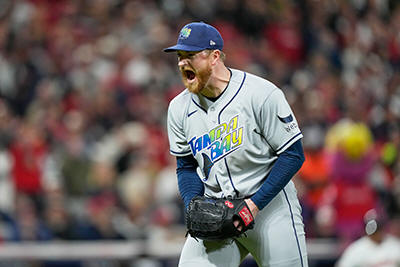
Tampa Bay Rays pitcher Drew Rasmussen celebrates the end of the
seventh inning against the Cleveland Guardians in Game 5 of an
American League Championship Series baseball game in Cleveland,
Sunday, Oct. 18, 2026. (AP Photo/David J. Phillip)

Tampa Bay’s leadoff hitter reached base in the
first four innings — scoring in the first three frames — and six
times overall. Rays' leadoff batters have reached in 10 of 14
innings dating to Saturday.
Díaz scored on a bases-loaded walk by Messick to DeLuca in the first
inning. Díaz led off with a line-drive double over center fielder
Petey Halpin that bounced on the warning track and off the wall.
Jonathan Aranda’s single drove in Ben Williamson for a 2-0 lead in
the second, and Liam Hicks looped a curveball from Herrin to center
to score Chandler Simpson in the third.
“I think we took advantage of getting ourselves in some favorable
counts and getting some big hits,” Cash said. “We probably left some
opportunities out there, and then they go to the bullpen, and it’s
really challenging to piece together big innings when they’re mixing
and matching from the third or fourth inning, whatever it was, on.”
Kwan helps keep Cleveland close
Kwan had two of Cleveland’s five hits and the four-time Gold Glove
winner made two fine defensive plays: He threw out Walls trying to
score from second base on Aranda’s fourth-inning single to left and
made a leaping catch at the center-field wall on Victor Mesa Jr.’s
eighth-inning drive, saving a run.
Messick had the shortest outing of his big league career and didn’t
make it past the third inning for the second time in four postseason
starts. The 25-year-old left-hander went two innings and allowed two
runs, five hits and three walks, throwing just 34 of 57 pitches for
strikes.
Cleveland has not won an ALCS when trailing 3-2 while the Rays are
58-27 at home this year, including the postseason.
The Guardians are seeking their first World Series title since 1948.
“We know we’ve got our work cut out for us. It’s a really good team
and a really good team when they play at home, especially,” manager
Stephen Vogt said. ”We know this is going to be tough but if there’s
a group I’m betting on to get this done, it’s our guys.”
Up next
Tampa Bay will start right-hander Freddy Peralta (1-0, 0.79 ERA
postseason), who will make his third appearance of the series. He
threw six scoreless innings in his Game 2 start and pitched
two-thirds of an inning in relief on Saturday. Cleveland has not
announced a starter, and Vogt ruled out using right-hander Gavin
Williams.
All contents © copyright 2026 Associated Press. All rights reserved
 |