Kiah Stokes' big night on both ends
leads Valkyries past Dream 64-55 and within a win of WNBA title
[October 27, 2026]
By JANIE McCAULEY
SAN FRANCISCO (AP) — Kiah Stokes kept swatting shots on the
interior, while Veronica Burton disrupted the Dream with her own
quick hands to alter shots.
And that crazed, violet-clad “Ballhalla” home crowd roared at every
chance — watching the Golden State Valkyries move one win away from
a championship in their second season with a 64-55 victory against
Atlanta in Game 5 of the WNBA Finals on Monday night.
Stokes had 13 points, eight rebounds and three blocks, and Burton
contributed a nearly identical stat line with 13 points, eight
rebounds and four blocked shots as Golden State got defensive once
more to shut down Angel Reese and the Dream.
The Valkyries have leaned on Stokes' steady presence and postseason
experience during this remarkable run.
“We’re not here without Kiah,” Burton said. “Every single day, every
single game, from the beginning. Just her veteran experience as
well. It's more than just defense.”
Reese finished with seven points, 15 rebounds and five assists — a
big difference from her two standout performances in the first two
games of the series at Chase Center. Reese shook her head when
whistled for the second of her three offensive fouls with 7:43 to
play.
“I still believe in our team, I still believe we can win this,”
Reese said.
Fans screamed and clapped thunder sticks following the final buzzer
as Stokes spoke from the floor to chants of “MVP!”
“We appreciate you,” a smiling Stokes said. “We got one more.”

On a night leading scorer Gabby Williams struggled to find her
shooting touch, Golden State found that “strength in numbers” mantra
coach Natalie Nakase has praised all season long and everybody made
an impact. Veronica Burton had 13 points, eight rebounds and her
postseason-best four blocks — tying Diana Taurasi in 2009 for most
by a guard in a Finals game.
On Saturday, Nakase had changed up her lineup for a 67-62 Game 4 win
by inserting Tiffany Hayes and Kaila Charles into the starting five.
She stayed with those two Monday night, and it worked again. Hayes,
who played 10 seasons for Atlanta and came out of retirement two
years ago, had 12 points — and Nakase has said she wants to win it
all for the veteran guard.
Williams began 2 for 11 and missed all four of her three 3-point
tries, but she converted a three-point play with 9:08 remaining put
the Valkyries ahead 49-42 and finished with nine points on 3-for-14
shooting and six rebounds.
Atlanta will now try to stave off elimination at home Thursday in
Game 6 and force a deciding Game 7 back here at Chase Center on
Saturday. The Dream hurt themselves with 17 turnovers that led to 21
points for Golden State.
[to top of second column] |

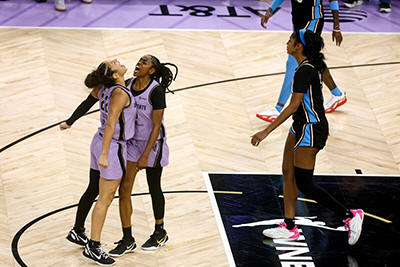
Golden State Valkyries guard Tiffany Hayes (15) celebrates with
guard Veronica Burton (22) after scoring against Atlanta Dream
forward Angel Reese (5) during the second half of Game 5 of the WNBA
basketball finals in San Francisco, Monday, Oct. 26, 2026. (Yalonda
M. James/San Francisco Chronicle via AP)

“Nothing’s changed, we win two games we’re champions,” Dream coach
Karl Smesko said.
Stokes hit a key 3-pointer with 2:46 to go in the third quarter and
another with 7:21 left in the game, which ignited chants of “Ki-ah!
Ki-ah!” from the rocking, rally-towel waving sellout crowd at Chase
Center.
“It feels pretty special,” she said. “I always know what I brought
to a team, I always understood my value but just to hear an arena
full of 18,000 fans it just really makes me feel appreciated and
loved.”
Stokes has recorded three or more blocks in six straight games,
tying her with Lisa Leslie in 2003 for the longest such streak in a
single WNBA postseason.
The Valkyries used a dominant second half after they led 25-22 at
the break, the lowest scoring first half combined score in WNBA
Finals history.
Rhyne Howard’s three-point play with 4:59 left in the third pulled
Atlanta within 34-31, but after that it was Stokes, Burton and the
Valkyries coming up with all the crucial plays on both ends.
"That’s just been our staple all season, we really rely on our
defense,” Stokes said.
Golden State owner Joe Lacob promised a championship within five
years in a bold declaration when the expansion franchise was granted
to the Bay Area three years ago, yet this season has exceeded even
what he could have envisioned.
Neither team could find a flow from 3-point range in the first half
as they combined to shoot 5 for 29 from deep — 3 of 16 by Golden
State and 2 for 13 by Atlanta.
Earlier Monday, the league announced Game 6 would be played at
17,000-seat State Farm Arena in Atlanta starting at 12:30 p.m. EDT
on Thursday — a time when many fans on both coasts will be working.
“I’d like to see it be a national holiday for all WNBA championship
games so whatever somebody can do,” Smesko said. “I hope everybody
gets to see it somehow and I know that for some people it’s not
realistic, they have jobs and won’t be able to make it. So I’m
disappointed for that but I’m really hopeful that as many people can
see the game as possible.”
All contents © copyright 2026 Associated Press. All rights reserved |