Wall Street rises as AI stocks keep swinging
[October 27, 2026] By
STAN CHOE
NEW YORK (AP) — U.S. stocks rose Monday amid shaky trading for financial
markets worldwide, as AI stocks kept swinging and Brazilian stocks
tumbled.
The S&P 500 rose 0.7% and more than recovered its losses from last week,
pulling within 1.8% of its all-time high set earlier this month. The Dow
Jones Industrial Average added 146 points, or 0.3%, and the Nasdaq
composite climbed 0.8%.
The strongest lift for the market came from Nvidia, which rose 2.4%.
That helped the chip company recover some of its drop from three
straight losing weeks, its longest such streak since June.
But stocks elsewhere in the artificial-intelligence industry remained
unsettled. They’ve been swerving on worries about whether their
industry’s boom is under threat because of how expensive it’s become for
companies to borrow money to build data centers and buy more AI chips.
Meta helps lead the swings
Meta Platforms bounced up and down after outlining plans to raise $35
billion by selling stock to help pay for its AI investments. It also
said it could raise another $60 billion by selling shares of a new class
of its stock once it begins trading. Meta’s stock initially dropped more
than 2%, but it quickly flipped to a gain and then pulled back to a loss
of 1.9%.
Meta said Nvidia, Advanced Micro Devices and Broadcom have already
indicated they may buy a total of $5 billion of stock in its offering.
Those are strong signals of interest from chip companies that stand to
benefit from additional AI investments. But they also give fuel to
critics of “circular financing” who say it raises the risk if AI isn’t
as successful as expected.
One big company at the center of the AI boom, Anthropic, gave details
Monday about how much money it’s losing as it prepares to sell its stock
on the publicly traded U.S. market for the first time.

Worries remain about borrowing for AI
SpaceX, Elon Musk’s rocket company that also runs the xAI business, had
similar swings after it announced a roughly $40 billion deal with an
entity managed by Apollo Global Management to lease AI computing power.
Its stock initially fell nearly 2% before flipping to a gain of 1.9% and
then finishing with a dip of 0.4%.
Musk warned over the weekend that hundreds of companies that rent out AI
computing power are under threat because of the difficulty in borrowing
money, saying on his social-media platform, X, that they could face
“guppy-level death and consolidation.”
CoreWeave, a company that’s borrowed money to buy AI computing power
that it rents to customers over the cloud, has been at the center of
investors’ worries in recent weeks. On Monday, it dropped 5.5% quickly
after trading began, only to flip to a gain of 6.6% before moderating to
a rise of 1.8%. Such minute-to-minute swings have become commonplace for
it in recent days.
All told, the S&P 500 rose 53.09 points to 7,676.77. The Dow Jones
Industrial Average added 146.42 to 52,361.58, and the Nasdaq composite
climbed 214.04 to 26,169.38.
It’s a big week for profit reports
Profit reports from huge tech companies this week could offer more
details about how spending on AI is going, and whether it’s producing
the profits and productivity that proponents promised.
Alphabet and Microsoft will report their latest quarterly results on
Wednesday, with Amazon to follow on Thursday.

[to top of second column] |

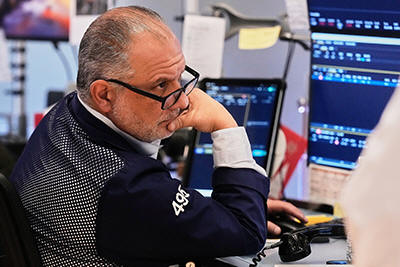
Trader Joel Lucchese works on the floor of the New York Stock
Exchange, Wednesday, Jan. 7, 2026. (AP Photo/Richard Drew, file)
 Companies across all industries are
under pressure to report strong growth in their profits.
Expectations for big growth are what allowed stock prices to run to
records recently despite worries about high inflation, high interest
rates and other concerns.
Verizon Communications fell 3.5% even though it reported a stronger
profit for the summer than analysts expected, as its revenue fell
short of forecasts.
Roughly one out of every three stocks in the S&P 500 is scheduled to
report its latest quarterly results this week.
Brazilian stocks tumble following mixed moves in other markets
In stock markets abroad, Brazilian stocks fell sharply after
President Luiz Inácio Lula da Silva won reelection in a result that
surprised investors.
The worry among investors is that he could increase the government’s
spending and put more pressure on its debt. The Bovespa stock index
in Brazil dropped roughly 14%.
Other governments around the world are also feeling pressure because
of high debt loads and strained budgets, including the United
States. France has been at the center of the worries recently
following violent protests in the country.
But yields on French government bonds eased Monday, and its CAC 40
stock index rose 0.8% for one of the world’s better moves. Indexes
also rose in other European markets following a mixed finish in
Asia.
The European Central Bank and the Bank of Japan will be meeting to
vote on interest rates later this week.
Yields ease ahead of the Federal Reserve’s meeting
In the U.S. bond market, yields fell for longer-term Treasurys. The
yield on the 10-year Treasury eased to 4.98% from 5.00% late Friday
and from more than 5.30% earlier this month.
The two-year Treasury yield rose to 4.71% from 4.69% late Friday. It
more closely tracks expectations for what the Federal Reserve will
do with overnight interest rates, and the widespread expectation is
that it will say on Wednesday that it is leaving the federal funds
rate alone following its latest meeting.
The Fed last month hiked the fed funds rate for the first time in
three years in hopes of slowing inflation, which has remained much
higher than anyone would like.

Oil prices swing
The price for a barrel of Brent crude swung between gains and losses
through the day before settling at $110.74, down 0.9%. It remains
near the high end of its range since the war with Iran began. The
highest price for the most actively traded contract in the market
for Brent crude since then is nearly $120, reached in March.
___
AP Business Writers Michelle Chapman and Elaine Kurtenbach
contributed to this report.
All contents © copyright 2026 Associated Press. All rights reserved |